What is Big Tech and who does it include?


The phrase “Big Tech” generally refers to a small group of technology companies whose platforms, infrastructure, and services underpin much of modern digital life.
Because these companies operate at a global scale and sit behind widely used accounts, devices, and online services, their design choices can shape how data is collected, shared, and managed across the internet. However, Big Tech is not a formally defined category, and its meaning can vary depending on context.
This article explains what "Big Tech" typically means, which companies are most often included, and why it matters.
What does "Big Tech" really mean?
“Big Tech” is a collective term used to describe the largest and most influential technology companies in the world. It commonly appears in journalism, business analysis, and policy discussions as a shorthand for firms whose platforms and services are widely used across regions and sectors.
These companies tend to operate at a significant scale and provide core digital services that people rely on daily, such as search, social media, operating systems, cloud computing, and e-commerce.
Origin of the term “Big Tech”
The phrase “Big Tech” began to appear in public discussion in the 2010s as a way to describe a handful of large technology companies whose influence in digital markets and everyday life had grown substantially. The label draws on a naming pattern similar to other industry group terms such as “Big Oil” or “Big Pharma,” which journalists and analysts have used for decades to refer to dominant firms in those sectors.
Related “Big Tech” terms
The term “Big Tech” also sits alongside a few related labels that people use in different contexts, including:
- Tech giants: Many journalists and analysts also use “tech giants” as a non-technical, descriptive alternative to “Big Tech.”
- FAANG: An acronym that stands for Facebook (Meta), Amazon, Apple, Netflix, and Google (Alphabet). It’s more commonly used in investment media to refer to key tech stocks.
- Gatekeepers: Under the EU’s Digital Markets Act (DMA), certain large digital platforms are designated as “gatekeepers” based on specific legal criteria, and this designation carries enforceable obligations.
What makes a company “Big Tech”?
Big Tech companies share a few traits, including:
- They operate digital platforms used at a global scale: This includes services such as online search, social networking, e-commerce marketplaces, or app stores.
- They act as intermediaries between different groups of users: Their platforms often connect businesses and end users, for example, through marketplaces, advertising systems, or app distribution.
- They provide core technology infrastructure: Many offer operating systems, web browsers, or cloud-computing services that other businesses and consumers rely on.
- They (often) run large digital advertising operations: Online advertising is a major revenue stream for several of these companies and underpins much of the modern digital economy.
The “Big Five” tech companies
The “Big Five” tech companies are a small group of technology firms that are most commonly associated with the term “Big Tech.” This group contains Apple, Microsoft, Google (Alphabet), Amazon, and Meta (Facebook), and it’s a common grouping rather than an exhaustive or official list.
Apple
Apple designs consumer devices and software that many people use daily, including smartphones, computers, tablets, and wearable technology. Its products are closely integrated with operating systems, cloud services, and an account-based ecosystem that connects devices and digital services.
Key products and services include:
- Devices: iPhone, iPad, Mac, Apple Watch, AirPods, HomePod, AirTag, Vision Pro
- Operating systems: iOS, macOS, watchOS, iPadOS, visionOS
- Digital services: App Store, iCloud, Apple Music, Apple TV+, Apple Pay, Apple Arcade
Apple is considered Big Tech because it operates at a scale few companies reach. In its 2025 financial statements, Apple reports more than $416 billion in total net sales. This revenue comes from a mix of hardware sales like the iPhone, which alone brought in $209.5 billion, and a growing digital services business.
Another indicator of Big Tech is its extensive reach. Reporting on the earnings call in 2025, CNBC quotes Apple CEO Tim Cook citing an active base of 2.35 billion devices, up from 2.2 billion in the previous year.
Beyond products, Apple operates key platform infrastructure relied upon by millions of developers and users. The iOS and iPadOS ecosystems distribute apps primarily through the App Store, governed by Apple’s App Store Review Guidelines that outline submission and review processes.
Together, Apple’s scale, broad installed base, and its platform-plus-services model place it within the Big Tech category.
Microsoft
Microsoft is considered Big Tech because it operates at a very large scale and provides core technology that underpins everyday computing for both individuals and organizations.
Key products and services include:
- Operating systems: Windows OS, Windows Server
- Productivity software: Microsoft Office suite (Word, Excel, PowerPoint), Microsoft 365
- Communication platforms: Teams, LinkedIn
- Cloud: Azure cloud platform
- Gaming: Xbox consoles, Xbox Game Pass
- Developer Tools: Visual Studio, GitHub
In its fiscal year ended June 30, 2025, Microsoft reported $281.7 billion in revenue, reflecting how widely it sells across consumer, business, and public-sector markets.
A major driver of this scale is Microsoft’s cloud services, which include Microsoft 365 Commercial cloud, Azure, LinkedIn’s commercial segment, and Dynamics 365. These subscription-based services contribute a large and growing portion of Microsoft’s business, moving it beyond traditional software sales.
Microsoft’s ecosystem is broad, spanning productivity tools, cloud infrastructure, business software, and widely used computing products across devices and workplaces.
Google (Alphabet)
Google, under its parent company Alphabet, operates some of the internet’s most widely used services, including search, online video, email, mobile operating systems, and cloud computing. Many of these products are connected through a Google Account and funded primarily by advertising and subscriptions.
Key products and services include:
- Search and advertising: Google Search, Google Ads
- Operating systems: Android OS, Chrome OS
- Software and services: Google Workspace (Gmail, Docs, Drive, Calendar, Meet), YouTube, Google Maps, Google Cloud Platform, Google Play Store
- Devices: Pixel phones, Nest smart home devices, Chromecast, Pixelbook laptops
- AI: Google Gemini, Waymo
Alphabet reported $350 billion in revenue for 2024, with most coming from Google Services, including Search, YouTube ads, and subscriptions. Its cloud division, Google Cloud, brought in $43 billion, making Alphabet a major player in both consumer internet and business infrastructure.
Alphabet’s platforms connect users, advertisers, and creators and benefit from network effects, meaning they become more valuable as more people use them. This scale and ecosystem breadth are key reasons Alphabet is categorized as a Big Tech company.
Amazon
Amazon runs a large online marketplace, logistics network, and cloud computing platform that support shopping, digital services, and business infrastructure.
Key products and services include:
- E-commerce: Amazon.com marketplace
- Cloud computing: Amazon Web Services (AWS)
- Entertainment: Prime Video, Amazon Music
- Devices: Alexa-powered Echo devices, Kindle e-readers, Fire tablets, Fire TV
In 2024, Amazon reported $638 billion in net sales, which is more than $1.7 billion per day. Notably, its service sales, which include third-party seller fees, advertising, Prime memberships, and AWS, made up a larger share of revenue than direct product sales.
Amazon’s mix of a huge marketplace connecting buyers and sellers, alongside AWS (one of the world’s largest cloud platforms), demonstrates the company’s broad ecosystem. This combination is why Amazon is firmly considered part of Big Tech.
Meta (Facebook)
Meta operates several global communication and social media platforms. These are primarily used to share content, message others, and consume media, and they’re largely funded through digital advertising.
Key products and services include:
- Social platforms: Facebook, Instagram, WhatsApp, Messenger
- Devices: Meta Quest, Ray-Ban Meta Smart Glasses
- Virtual reality: Metaverse, Meta Horizon
- Advertising: Digital advertising platform across all its apps
- Developer tools: Facebook Developer tools for app creation and analytics
Meta is considered Big Tech because it runs a global digital infrastructure. In Meta’s 2024 annual filings, the company reported $164.5 billion in revenue, driven by a vast, engaged audience and consistent advertiser spending.
The same report shows Meta’s scale in its usage metrics: 3.35 billion daily active users across its Family of Apps. This highlights why Meta is often seen as a platform company that connects people, businesses, and advertisers at an enormous scale.
Revenue largely comes from ads, with ad impressions and average ad prices both increasing in 2024. This means Meta’s business grows as more people use its apps and advertisers compete to reach them.
What areas does Big Tech influence?
Big Tech influence tends to concentrate in the same “layers” that regulators inspect when they talk about large platforms: communications, operating systems and browsers, cloud computing, and online advertising. In everyday terms, that means the places where your identity, attention, and data flow through default systems.
Data and personal information
Big Tech companies collect first-party data as part of providing account-based products and services. When you sign in with an account from companies such as Apple, Google, Microsoft, Amazon, or Meta, that account can be used across multiple services, including email, cloud storage, messaging, app downloads, and connected devices. As a result, activity across those services is linked to a single user account.
Because these platforms are widely used for everyday digital tasks, a relatively small number of companies essentially handle a large share of the personal data people create online.
Platforms for communication and media
Big Tech companies operate many of the most widely used messaging services, social networks, and video platforms where people spend time online. These platforms do more than simply host content; they organize and prioritize what users see within their services through ranking systems often powered by machine learning.
For example, Meta describes using machine learning systems to rank content in Facebook Feed. It also describes Instagram Feed ranking as an AI system that orders posts by predicting what a person will find valuable and relevant. YouTube similarly documents that recommendations are driven by signals and viewing patterns and that its system compares viewing habits with those of similar users to suggest other content.
In messaging services, platform design choices affect privacy features such as default encryption settings, metadata collection, message synchronization across devices, and options for backups and account recovery. These technical and policy decisions influence the extent to which users can maintain privacy within those platforms and the ease of transferring data between services.
Cloud services and devices
Cloud services provide the underlying infrastructure that supports many digital products and services. Files, photos, and app data often sync across devices through cloud storage, and these services can scale rapidly because infrastructure is typically rented rather than owned.
The other side is infrastructure. Even when you’re not using a Big Tech product directly, many apps and websites rely on large cloud platforms to host data and run services. That can concentrate reliability and scale in a small number of providers, which shapes how other companies build, price, and operate their products.
Digital advertising and algorithms
Digital advertising is a primary revenue source for many Big Tech companies, which influences how their platforms operate. Ads are often personalized using data collected across multiple services linked to a user’s account or device. This data may include search history, app activity, location, and interactions, which together create a profile used to deliver ads tailored to individual interests.
This personalization aims to make ads more relevant, but it may also involve ongoing tracking of user behavior across platforms.
What are the pros and cons of Big Tech?
The broad scope of Big Tech tends to make digital life smoother. Accounts sync across devices, services scale fast, and products often “just work” together. The trade-off is that convenience can come with dependencies when the same few companies sit behind the devices, cloud accounts, and ad systems people rely on daily.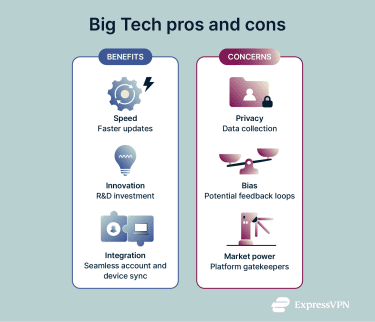
Benefits
Because of how Big Tech is structured and operates, new features roll out quickly, infrastructure can scale on demand, and ecosystems reduce friction between devices and apps. Those strengths show up in three practical ways.
Speed
Because Big Tech companies operate global-scale platforms often supported by proprietary cloud infrastructure, they can typically deploy updates quickly and scale computing resources dynamically during peak demand.
As a result, services such as streaming, messaging, and file synchronization can stay responsive during peak load. Design or policy changes can also affect millions of users relatively quickly due to this scale.
Innovation
Big Tech companies can fund long-term research and development at levels few firms can match, enabling sustained innovation and ongoing improvements to existing products and services.
These investments support new technologies, infrastructure enhancements, and security research at a scale generally beyond smaller competitors.
Integration
Integration is where Big Tech feels most valuable for many users. Because these companies tightly integrate their devices and services, they simplify everyday tasks like switching phones, recovering data, and maintaining consistent access across products.
For example, Apple’s ecosystem allows its devices to work together smoothly, with features like Handoff, AirDrop, and iCloud syncing enabling you to move effortlessly between devices. Similarly, a Google Account can allow you to access a wide range of services across Android devices and the web, including Gmail, Google Drive, YouTube, and Chrome browser sync, all linked through a single login.
Potential concerns
The concerns around Big Tech go beyond market size to include how their business incentives, automated systems, and control over digital distribution affect what people experience, what data may be collected, and which alternatives can realistically compete.
Privacy
Many Big Tech companies, including Meta and Alphabet (Google), provide widely used free services funded primarily through advertising. This model involves trade-offs: users receive free or low-cost services, while companies collect data to improve ad targeting and measure effectiveness.
Privacy considerations go beyond advertising and encompass how these platforms aggregate and manage significant amounts of personal data across multiple devices and services. This data aggregation can create detailed user profiles and enable cross-device tracking that follows users across apps and websites. The length of time data is stored and the extent to which it may be shared with third parties varies by company, policy, and jurisdiction and is outlined in each platform’s privacy policy.
Finally, while Big Tech companies generally invest heavily in security measures to protect user data, it is important to acknowledge that no system is completely immune to data breaches or unauthorized access.
Bias
Considerations around bias occur when large technology platforms use machine learning systems to rank, recommend, or target content at scale. These systems are widely used by Big Tech companies across search, social media, advertising, and content distribution, and they influence what information users are most likely to encounter.
In March 2022, a study by the U.S. National Institute of Standards and Technology (NIST) noted that AI systems can increase the speed and scale at which existing biases are reproduced or amplified. In the context of large platforms, this may result in feedback loops that prioritize certain content or behaviors over others, particularly when algorithms optimize for signals such as user engagement or past performance.
Many Big Tech companies actively monitor and update their algorithms to identify and mitigate bias, though the complexity and scale of these systems mean challenges remain.
Market power
Because Big Tech companies operate widely used digital platforms, regulators sometimes assess their market position under specific legal frameworks. As mentioned, the EU’s DMA allows the European Commission to designate certain large digital services as “gatekeepers” when they function as key access points between businesses and users.
This designation reflects concern about how default platforms can influence user choice and competition. App stores, operating systems, search engines, social networks, and messaging services are treated as “core platform services” because decisions made at this level can affect what users can install, find, or use, as well as how businesses reach customers.
Why do some experts call for regulation?
Researchers, policy analysts, and regulatory bodies have expressed concerns about the concentration of power within a small number of large technology companies that dominate key parts of the digital economy. These include major digital platforms, data ecosystems, and online marketplaces. This concentration may limit competition, raise privacy risks, and create challenges in addressing harmful content or algorithmic decision-making.
What are the risks of limited oversight?
When regulatory oversight is limited, platforms may collect significant amounts of user data and track activity across devices and services. This brings up important questions about privacy. Additionally, broader systemic issues may be less visible or harder to address if oversight focuses only on individual companies.
Can Big Tech self-regulate?
Big Tech companies have implemented various self-regulatory measures, including publishing transparency reports, enforcing community standards, and maintaining internal safety and security teams. Some have also established independent or semi-independent review bodies; for example, Meta’s Oversight Board operates with financial support from a trust that includes Meta’s funding alongside independent sources.
However, independent observers note that ultimate control over platform policies and enforcement remains with the companies themselves, which can influence the scope and consistency of self-regulation efforts.
How to take more control over your digital footprint
Fully opting out of major digital platforms is difficult in today’s connected environment. However, there are practical steps you can take to reduce how much of your data is linked across services and improve your overall privacy.
Choose privacy-focused tools
You can start managing your privacy with tools that protect your accounts and reduce passive tracking across the board. Here are the most effective options: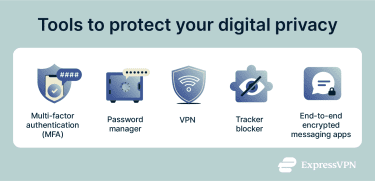
- Password manager: Use a password manager to create strong, unique passwords for every online account. This practice helps contain the impact of any single data breach.
- Multi-factor authentication (MFA): Turn it on for your email and primary platform accounts, so a password alone can’t unlock the services that anchor your devices, storage, and login.
- Privacy-focused web browser: Pick a browser with strong anti-tracking features, since web browsers are common points for data collection used in advertising, analytics, and cross-site profiling.
- Virtual private network (VPN): A VPN encrypts traffic between your device and the VPN server, protecting data (especially on public Wi-Fi networks) and masking your IP address from websites. While VPNs don’t block tracking via logins, cookies, or fingerprinting, they’re effective at reducing your network-level visibility.
- Tracker blocking: A tracker blocker like ExpressVPN Threat Manager can block your device from communicating with known tracking and malicious domains. This reduces data flows connected to advertising and analytics ecosystems commonly operated by large technology companies.
- Encrypted messaging apps: For sensitive conversations, consider using messaging apps that support end-to-end encryption, which prevents the service provider from accessing message content during transmission.
Limit data sharing
If you want to reduce your digital footprint, there are a few ways to control how your data is shared and linked across platforms:
- Manage ad personalization settings: Most major platforms let you control whether your data is used to personalize ads and how widely it’s shared. For example, Google’s My Ad Center, Microsoft’s ad settings, and Meta’s Accounts Center provide options to adjust ad preferences and limit data sharing.
- Control cross-app tracking on mobile devices: Cross-app tracking connects your activity across different apps and websites, often for advertising or data broker sharing. On iOS devices, you can manage this through the “App Tracking Transparency” settings, allowing you to decide which apps are permitted to track your activity across other apps.
- Review and delete voice assistant recordings: Virtual assistants store recordings of your voice commands. Regularly reviewing and deleting Siri, Alexa, and Google recordings helps limit the data retained by these services.
- Use data removal services: Consider a data removal service to help remove or limit the amount of your personal information available on data broker sites.
Diversify the apps and platforms you use
Big Tech’s influence can become entrenched when multiple services and devices rely on a single account. For example, one login might connect your phone, backups, photos, purchases, and third-party apps, creating dependencies that are difficult to break. To reduce this “stickiness,” consider these strategies:
- Use an independent primary email: Choose an email address not tied directly to your phone or device ecosystem as your main account recovery contact. This helps separate your digital identity from any single platform.
- Limit single sign-on (SSO) usage: While signing in with Google, Apple, or Facebook accounts can be convenient, relying on one login for multiple services increases risk if that account is compromised or inaccessible.
- Separate critical services: Use different providers for key services such as password management, email, and cloud storage to reduce the impact of any single provider’s outage or policy changes.
- Close unused accounts: Regularly review and close accounts you no longer use to limit the personal data tied to inactive or forgotten services.
- Maintain exportable backups: Keep copies of important data like contacts, photos, and documents in portable formats so you can move your information if needed.
- Use multiple recovery options: Ensure your main accounts have more than one recovery method (such as email and phone number) to prevent being locked out if one device or method fails.
Educate yourself about digital privacy and tech choices
Building a basic understanding of digital privacy empowers you to make more informed decisions about the services and platforms you use. Focus on learning key concepts like data privacy and tracking technologies to better grasp how your information is collected and used.
Regularly reviewing privacy and security settings on your accounts is essential. Platforms often update their policies and features, so staying informed helps you maintain control over your personal data and adapt your habits as needed to protect your digital footprint.
FAQ: Common questions about Big Tech
What companies are considered Big Tech today?
Most people consider Apple, Microsoft, Google (Alphabet), Amazon, and Meta to be Big Tech companies. Some lists also include companies like Nvidia, Tesla, and OpenAI.
What does FAANG stand for?
FAANG stands for Facebook (now Meta), Apple, Amazon, Netflix, and Google. It started as an investing acronym for large, high-growth tech stocks, which means it’s not a formal definition of “Big Tech.”
How does Big Tech use my data?
Big Tech companies collect and use data to provide and improve their services. This typically includes information you provide directly, such as account details and content you create, as well as data gathered from your activity across their platforms and devices. This data helps personalize features, deliver relevant content and ads, enhance security, and support service functionality. How data is used and shared varies by company and is outlined in their privacy policies and settings, which you can review and manage.
Can I live without Big Tech?
Partially, yes. Completely avoiding Big Tech is challenging for most people because many essential services, such as email, maps, app stores, payment systems, cloud hosting, and workplace tools, are deeply integrated with these companies. A practical approach is to gradually reduce dependence by switching one category at a time (like email, browsers, messaging, or cloud storage) while maintaining exportable backups of your data.
What’s the role of Big Tech in AI?
Big Tech companies provide the three key components AI requires at scale: computing infrastructure, large datasets, and distribution. They typically invest heavily in AI research and integrate AI features across their products, including search engines, social feeds, productivity tools, customer support, advertising, and security systems. By doing so, they shape how AI technologies are deployed and set many of the default ways users experience AI in everyday digital services.
How is Big Tech using quantum computing?
Many Big Tech firms are investing in quantum computing research and development to explore its potential in areas like cryptography and complex problem-solving. While still experimental, these efforts focus on building quantum hardware and software, with practical applications expected in the future.
What’s the history of Big Tech?
It traces back to the rise of personal computing and software in the late 20th century, then accelerates with the internet, smartphones, cloud computing, and online advertising. Over time, a few companies gained significant influence by controlling key gateways, operating systems, app distribution, and ad infrastructure.
How does Big Tech impact society?
Big Tech plays a significant role in increasing access to information, supporting new business models, and enhancing productivity. Its platforms influence how people discover and engage with content through ranking systems, while its scale affects market dynamics across industries. The extensive collection and use of data also involve important considerations around privacy and the role of automated systems in decision-making.
Take the first step to protect yourself online. Try ExpressVPN risk-free.
Get ExpressVPN